+6.4R in 30 days
Maya R.
Part-time futures trader
Maya reduced her watchlist to MNQ only, followed Kleopatra signals during the New York open, and cut her average hold time by 38% after journaling every exit.
Backtested strategy reports, a step-by-step getting-started guide, and a plain-language glossary — everything you need to trade our signals with discipline.
50+
Backtested strategies
Weekly
Market briefings
1,200+
Active traders
Jan 2023 – Sep 2024 · Micro Nasdaq 100 futures
Kleopatra trades confirmed breakouts on the 5-minute MNQ chart using a volatility-adjusted entry trigger, structural invalidation stops, and a 2R take-profit. The model is designed for traders who want a small number of high-conviction setups per session rather than constant noise.
Total trades
412
Win rate
58.2%
Avg R per trade
+0.41R
Profit factor
1.74
Max drawdown
−7.9%
Sharpe (annualized)
1.62
Past performance is based on backtested results and does not guarantee future returns. Trading futures carries substantial risk of loss.
A 5-minute walkthrough of a real MNQ breakout signal from trigger to exit. Watch how confirmation, invalidation, and the 2R take-profit work together.
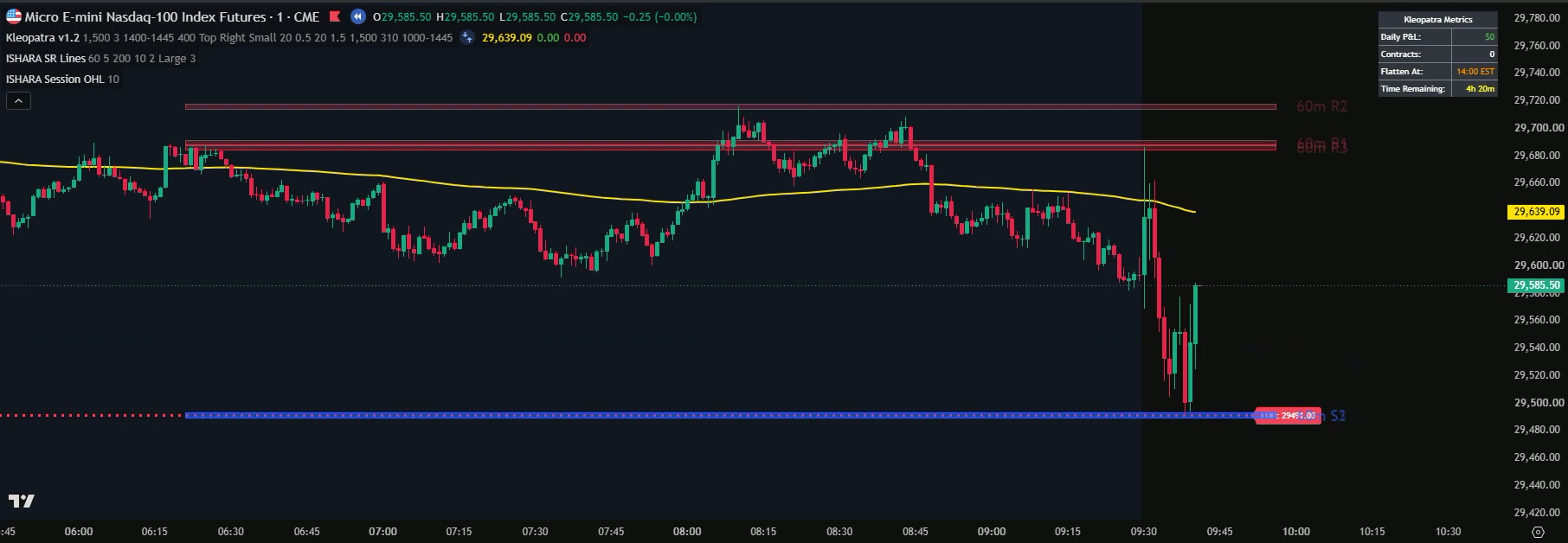
Past performance is shown for educational purposes only and does not guarantee future results. Trading futures carries substantial risk of loss.
A concise setup walkthrough that takes you from a TradingView alert to an automated order in your broker via TradersPost. Follow the steps in order and verify each stage before going live.
External video content is provided for educational purposes. Ishara Analytics is not affiliated with YouTube, TradingView, or TradersPost.
Preparing for a demo or activation session? Download TeamViewer QuickSupport ahead of time and we'll connect TradingView and TradersPost on your computer together.
We use TeamViewer to help you connect TradingView and TradersPost on your own computer. Download it before your session so we can get you set up quickly.
We will never contact you first asking for remote access. Only connect during a session you booked, and never share your broker or exchange passwords with anyone.
A five-step path that mirrors what our most disciplined members did in their first month. Work through it in order — don't skip the paper-trading week.
Link your futures broker and TradingView account, then enable the Ishara overlay. Most traders are connected in under ten minutes.
Start with a single strategy — we recommend Kleopatra for MNQ traders. Following one model removes second-guessing while you learn our signal language.
Use your broker's simulator to take every published signal for five trading sessions. The goal is mechanical execution, not P&L.
Risk a fixed 0.25% of account per trade for your first month. This keeps emotion low while you build trust in the signals.
Every Sunday, compare your executed trades to the published signals. Note any deviations — execution discipline is the #1 driver of long-term results.
Plain-language definitions for every term, metric, and acronym you'll see across Ishara Analytics signals and reports.
The best signal still needs strict sizing, clear invalidation, and an exit plan. These are the operating rules we recommend for traders using Ishara Analytics on intraday futures.
Start every trade with a predefined risk unit. New members use 0.25% of account equity per setup, while experienced traders rarely exceed 0.75% on any single idea.
Stop trading for the session after −1.5R or three consecutive invalidated signals. The goal is to protect decision quality before frustration takes over.
If a signal reaches invalidation, the trade is closed. Stops are only tightened after price reaches +1R; they are never moved farther from entry.
Every Friday, compare planned risk, realized R, skipped trades, and rule breaks. Reduce size the following week if execution errors exceed two trades.
Subscriber-only templates: trade journal, weekly review, and risk planner. Available to active Lite and Pro members.
Example case studies based on common member outcomes: tighter execution, fewer rule breaks, and more consistent risk habits.
+6.4R in 30 days
Part-time futures trader
Maya reduced her watchlist to MNQ only, followed Kleopatra signals during the New York open, and cut her average hold time by 38% after journaling every exit.
72% fewer rule breaks
Swing trader learning intraday execution
Daniel used the daily loss limit and pre-trade checklist to stop revenge trading. His biggest improvement came from skipping signals when volatility was below the model threshold.
Passed phase one in 18 sessions
Prop-firm evaluation trader
Priya kept risk at 0.25% per trade, avoided scaling up after wins, and used the weekly review worksheet to identify that most losses came after 11:30 ET.
Get a personalized walkthrough of Ishara Analytics and see how our signals fit your trading goals.